
| Functions |
|
|---|---|
| Structures |
|
For your massage practice
- Every massage stroke is first a message to the nervous system - skin and muscle receptors send it to the spinal cord and brain, which shape how it feels
- Slow, rhythmic, predictable touch is associated with a shift towards parasympathetic ("rest and digest") activity; sudden or painful pressure can trigger a protective, sympathetic response
- Watch for reduced sensation (for example, diabetic feet or after a stroke) - the client may not be able to tell you if pressure is too much, so use lighter pressure and check in often
- Numbness, pins and needles or weakness that follows a dermatome or myotome pattern can point to nerve root irritation - do not work into it; suggest the client see their GP or physiotherapist
- Numbness around the groin or buttocks with new bladder or bowel changes is a medical emergency - stop and advise the client to seek urgent medical help (000 or emergency department)
- Avoid sustained deep pressure over superficial nerves in "endangerment sites" such as the medial elbow (ulnar nerve), the axilla and the back of the knee
Overview
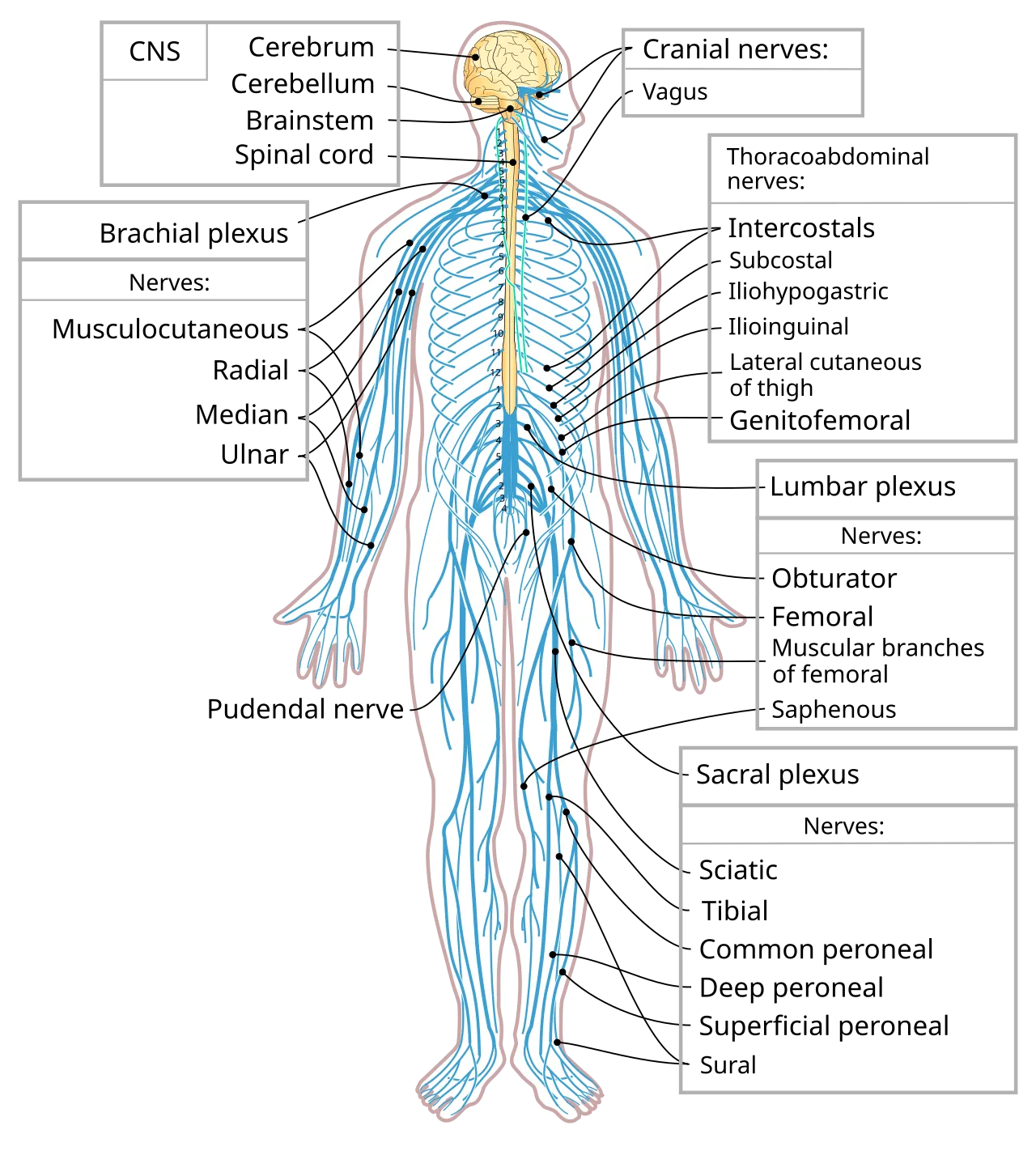
The nervous system is the body’s control and communication network. It has two main parts. The central nervous system (CNS) is the brain and spinal cord. The peripheral nervous system (PNS) is everything outside them: 12 pairs of cranial nerves and 31 pairs of spinal nerves, which branch out to the skin, muscles, joints and organs.
The PNS has a somatic division, which controls skeletal muscle and carries sensation from the body, and an autonomic division, which runs organs without conscious effort. The autonomic system is split into the Sympathetic nervous system (“fight or flight”), Parasympathetic nervous system (“rest and digest”) and enteric (gut) divisions.
How it works
Nerve cells (neurons) carry electrical signals. Sensory (afferent) neurons carry information towards the CNS, and motor (efferent) neurons carry instructions away from it to muscles and glands. Glial cells support, feed and insulate the neurons; some make myelin, which speeds up signals.
Spinal nerves leave the spinal cord at each level as a Nerve root. In the neck, lower back and pelvis the roots mix together in a Plexus before forming named nerves such as the median, ulnar and sciatic nerves. This is why one spinal level supplies a strip of skin and a group of muscles, not a single spot.
Dermatomes
A Dermatome is the area of skin supplied mainly by one spinal nerve root. On the trunk they run in horizontal bands; on the limbs they run lengthways. Useful reference points: C5 lateral elbow, C6 thumb, C7 middle finger, C8 little finger, T4 nipple line, T10 navel, L4 medial ankle, L5 top of the foot, S1 lateral heel. The exact borders vary from person to person, and C1 has no dermatome.
Myotomes
A myotome is the group of muscles supplied mainly by one nerve root. Clinicians test them with resisted (isometric) movements, looking for weakness. Commonly used tests: C5 shoulder abduction, C6 elbow flexion and wrist extension, C7 elbow extension and wrist flexion, C8 thumb extension or finger flexion (sources differ), T1 finger abduction, L2 hip flexion, L3 knee extension, L4 ankle dorsiflexion, L5 big-toe extension, S1 ankle plantarflexion and eversion.
Reflexes
A reflex is a fast, automatic response that travels along a reflex arc: receptor, sensory neuron, spinal cord, motor neuron, muscle. In the stretch reflex, muscle spindles sense a quick stretch and the same muscle contracts to resist it; this helps hold posture. Tapping a tendon tests it: biceps (C5–C6), brachioradialis (C6), triceps (C7), patellar or knee jerk (L3–L4) and ankle or Achilles (S1). Reduced reflexes suggest a peripheral problem; exaggerated ones suggest a central one.
Relevance to massage
Massage works largely through the nervous system. Pressure, stretch and warmth are detected by receptors and interpreted by the brain, which is why the same stroke can feel soothing to one client and threatening to another (see Pain, the pain gate and the nervous system and Relaxation and the parasympathetic response). A calm, predictable pace helps the nervous system settle.
As a Cert IV therapist you do not diagnose nerve problems, but knowing dermatome and myotome patterns helps you notice when symptoms follow a nerve root rather than a muscle. Numbness, tingling, weakness or pain shooting down a limb are reasons to work around the area and refer the client to their GP or physiotherapist. Loss of bladder or bowel control with numbness in the “saddle” area is an emergency.
Key terms
- CNS / PNS: brain and spinal cord / all the nerves outside them.
- Afferent / efferent: carrying signals towards / away from the CNS.
- Dermatome / myotome: skin area / muscle group supplied mainly by one nerve root.
- Reflex arc: the pathway of an automatic response.
- Proprioception: the sense of body position (see Proprioception).
Key terms
Central nervous system (CNS)Peripheral nervous system (PNS)Afferent (sensory) and efferent (motor)DermatomeMyotomeReflex arcSympathetic and parasympatheticNerve root and plexus