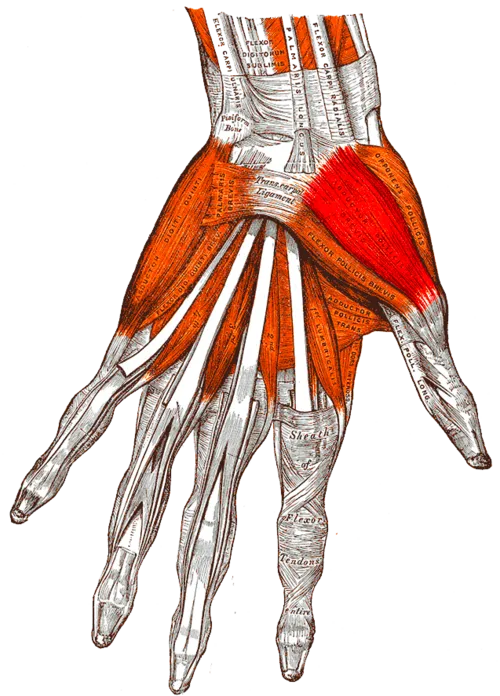

| Origin |
|
|---|---|
| Insertion |
|
| Action |
|
| Nerve | Recurrent branch of the median nerve; the deep head of flexor pollicis brevis is often supplied by the deep branch of the ulnar nerve (C8–T1) |
| Name | Greek thenar, 'palm of the hand'. |
Palpation
- Client supine with the hand palm up and relaxed.
- Find the fleshy mound at the base of the thumb (the thenar eminence).
- Ask the client to lift the thumb straight up from the palm; feel abductor pollicis brevis along the outer edge of the mound.
- Ask the client to touch the tip of the thumb to the tip of the little finger; feel opponens pollicis firm deep in the mound.
The thenar muscles are the three small muscles in the ball of the thumb: abductor pollicis brevis (on top), flexor pollicis brevis, and opponens pollicis (underneath). Together they let the thumb reach across the palm to meet the fingertips, which is what makes a pinch or precision grip possible. Adductor pollicis, the muscle in the web between thumb and index finger, is nearby but is not part of this group.
Massage therapists use their thumbs constantly, so this group is worth looking after in your own hands; see Therapist self-care and body mechanics. For clients, small thumb-pad Circular friction and gentle Petrissage of the mound feel good in a hand routine. Keep pressure light at the wrist crease just above the mound, where the median nerve enters the hand.
Sources disagree on the nerve roots. Wikipedia gives C8–T1 (used here), while Gray’s (1918) gives C6–C7. Wikipedia also notes that opponens pollicis is supplied by the ulnar nerve in about one person in five.