
| Origin |
|
|---|---|
| Insertion |
|
| Action |
|
| Nerve | Deep branch of the ulnar nerve (C8–T1) |
| Name | Greek hypo, 'under', and thenar, 'palm' — the lesser mound of the palm. |
Palpation
- Client supine with the hand palm up and relaxed.
- Find the pisiform at the little-finger side of the wrist crease; the fleshy mound just beyond it is the hypothenar eminence.
- Ask the client to spread the little finger away from the ring finger; feel abductor digiti minimi along the outer border of the hand.
- Ask the client to cup the palm, bringing the little finger towards the thumb; feel opponens digiti minimi firm deeper in the mound.
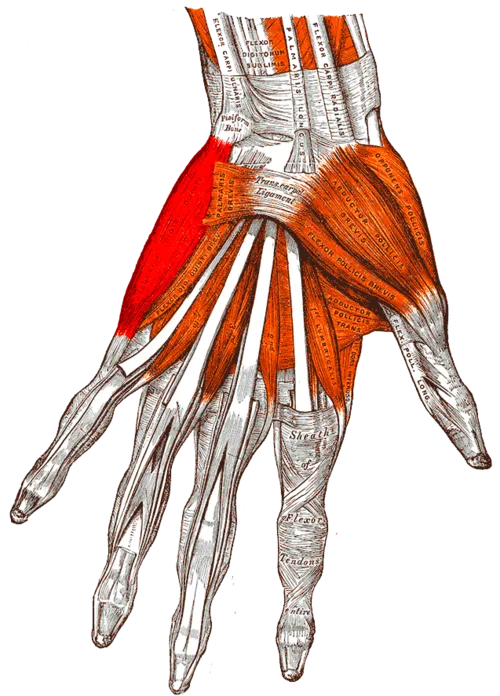
The hypothenar muscles are the three small muscles on the little-finger side of the palm: abductor digiti minimi (along the outer edge), flexor digiti minimi brevis, and opponens digiti minimi (deepest). They help cup the hand and steady the little finger when gripping. Some texts also mention palmaris brevis, a thin muscle in the skin over this area, but Wikipedia does not count it as part of the group.
The ulnar nerve and artery pass into the hand between the pisiform and the hook of the hamate, just above this mound. Keep pressure light there and work the fleshy part of the mound instead. Thumb-pad Circular friction and gentle Petrissage suit a hand routine, and this area is also useful for your own self-care after a day of massage.
Wikipedia gives roots C8–T1 (used here); Gray’s (1918) gives the eighth cervical nerve only.