
| Functions |
|
|---|---|
| Structures |
|
For your massage practice
- Bony landmarks are the map for finding muscles - the spine of the scapula, iliac crest, PSIS and greater trochanter guide your hands
- Work around, not onto, bony prominences and joint lines; press into soft tissue, not bone
- Osteoporosis makes bones fragile - use lighter pressure, avoid heavy compression and percussion, and take care with rib springing or pressure over the ribs
- Joints can be moved passively (passive range of motion) within a comfortable range; never force a joint past its end range
- Refer a client with bone pain that is constant or worse at night, a suspected fracture, or a hot, swollen joint
Overview
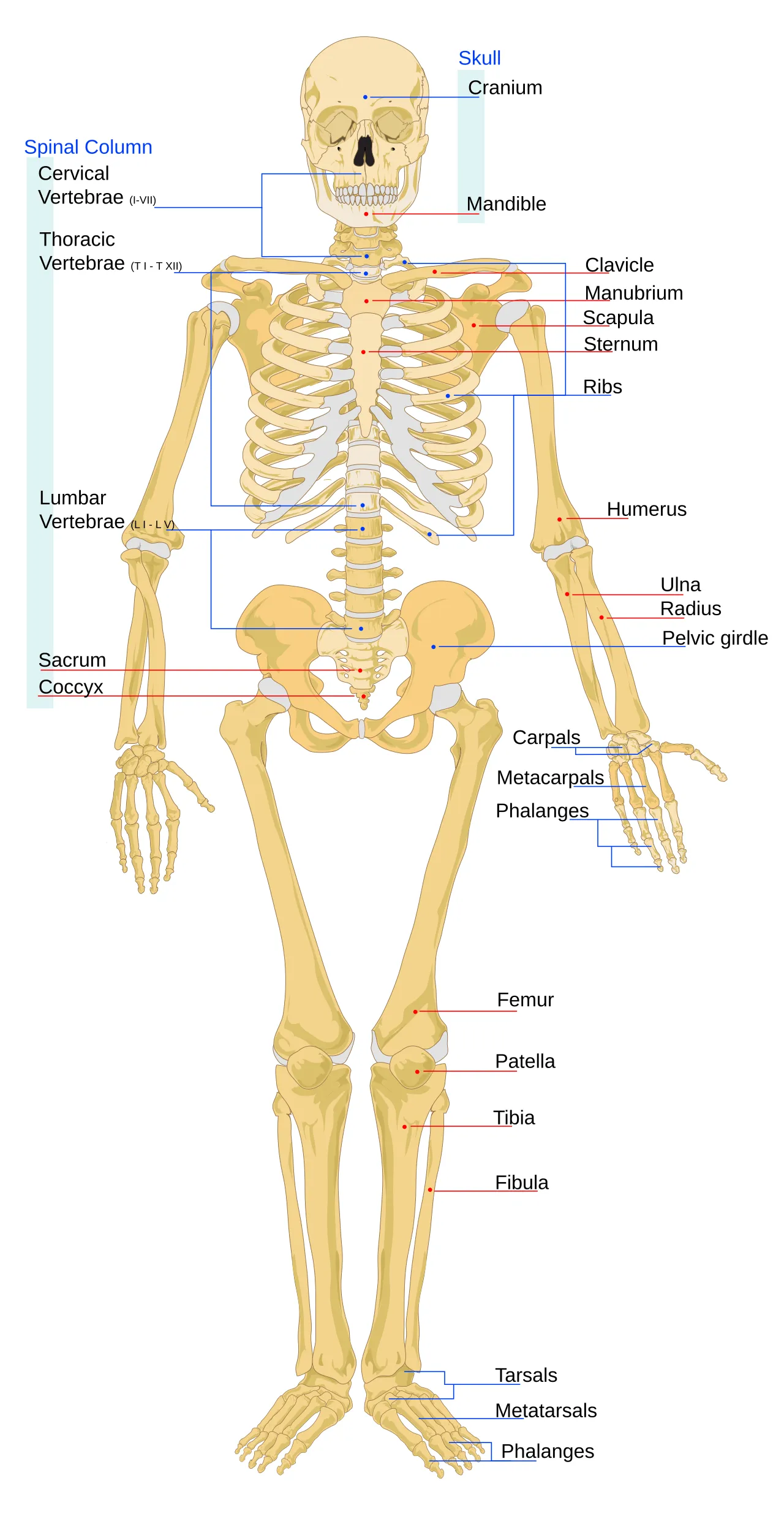
An adult skeleton has about 206 bones (a newborn has more, roughly 270–300, and many fuse as we grow). The axial skeleton (80 bones) is the skull, spine, ribs and sternum. The appendicular skeleton (126 bones) is the shoulder and pelvic girdles and the limbs. Bones are living tissue: osteoblasts build bone, osteoclasts break it down, and the skeleton is constantly remodelled.
Bone types
- Long: longer than wide, with a shaft and two ends, e.g. femur, humerus, phalanges.
- Short: roughly cube-shaped, e.g. carpals of the wrist and tarsals of the ankle.
- Flat: thin and often curved, e.g. most skull bones, sternum, ribs, scapula.
- Irregular: complex shapes, e.g. vertebrae, pelvic bones, some skull bones.
- Sesamoid: sit inside a tendon, e.g. the Patella and pisiform.
How it works
Bone has a hard outer layer of compact bone and an inner lattice of spongy bone, which holds red marrow (blood-cell factory) in many adult bones. The Periosteum covers the outside and is rich in nerves, which is one reason pressing on bone is uncomfortable.
Joint classification
By structure, joints are fibrous (e.g. skull sutures), cartilaginous (e.g. intervertebral discs, pubic symphysis) or synovial. By function, they are synarthroses (immovable), amphiarthroses (slightly movable) or diarthroses (freely movable). Nearly all diarthroses are synovial joints: the bone ends are covered in smooth cartilage, wrapped in a capsule lined by a synovial membrane, and lubricated by synovial fluid. Ligaments and sometimes a Bursa or meniscus add stability and reduce friction.
Synovial joint types
- Ball and socket (hip, shoulder): flexion/extension, abduction/adduction, rotation and circumduction.
- Hinge (elbow, knee, ankle): mainly flexion and extension.
- Pivot (atlas on axis in the neck, proximal radio-ulnar joint): rotation.
- Condyloid or ellipsoid (wrist, knuckles): flexion/extension and abduction/adduction.
- Saddle (base of the thumb): flexion/extension, abduction/adduction; lets the thumb oppose.
- Plane or gliding (between carpals, facet joints of the spine): small sliding movements.
Relevance to massage
Bony landmarks such as the Spine of scapula, Iliac crest, Posterior superior iliac spine and Greater trochanter are how you find muscles and plan strokes. Pressure should sink into soft tissue, not grind on bone or joint lines. Knowing the joint type tells you which movements are safe during Passive range of motion.
Bones weakened by osteoporosis or cancer can break under pressure that would be safe for others, so ask about bone health at intake and adjust. Refer a client with constant or night-time bone pain, a suspected fracture, or a hot, red, swollen joint.
Key terms
- Axial / appendicular: central skeleton / limbs and girdles.
- Synovial joint: a freely movable joint with a fluid-filled capsule.
- Ligament: connects bone to bone; a tendon connects muscle to bone.
- Articular cartilage: the smooth covering on bone ends inside a joint.
Key terms
Axial and appendicular skeletonLong, short, flat, irregular and sesamoid bonesPeriosteumSynovial jointLigamentArticular cartilageBursa