
| Functions |
|
|---|---|
| Structures |
|
For your massage practice
- Skeletal muscle and fascia are the main tissues a massage therapist touches and works with
- Knowing origin, insertion and action lets you position the client, find the muscle and work along its fibres
- Clients often report feeling looser and less tense after massage; research shows short-term changes in how muscles feel and small, short-lived gains in flexibility rather than lasting structural change
- After hard exercise, massage is associated with less delayed-onset muscle soreness (DOMS)
- Refer when muscle pain comes with unexplained weakness, severe swelling, or a recent injury with bruising and loss of function
Overview
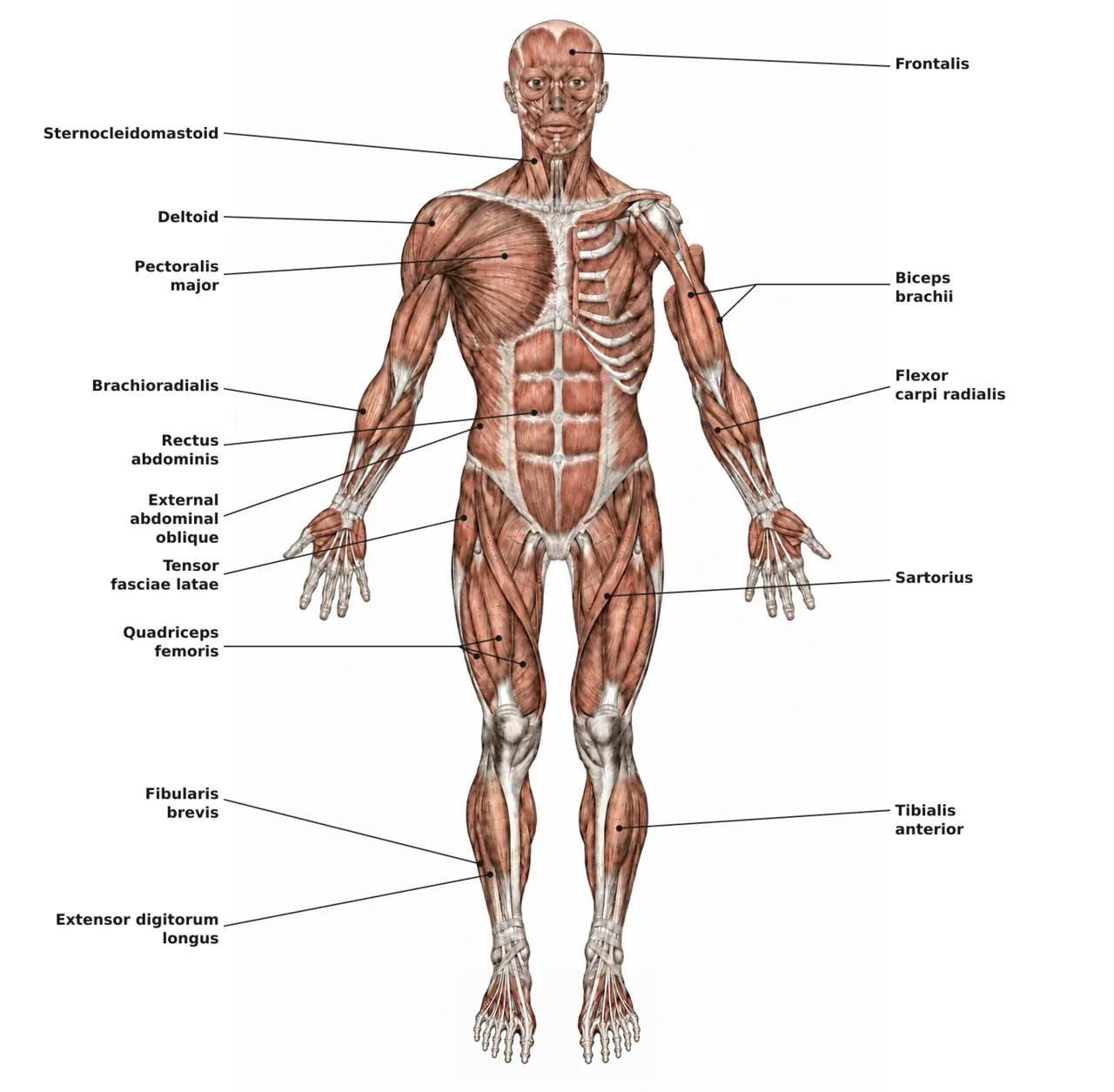
The muscular system is made of more than 600 skeletal muscles (the exact count depends on how you count them), which make up roughly a third or more of body weight. There are three types of muscle tissue. Skeletal muscle is striped (striated) and under voluntary control. Cardiac muscle is found only in the heart. Smooth muscle lines hollow organs and blood vessels and works automatically.
For massage, “the muscular system” mostly means skeletal muscle and the connective tissue around it: Tendons, aponeuroses and Fascia.
How it works
A muscle is built from long cells called fibres, bundled into fascicles and wrapped in fascia. A motor neuron and all the fibres it controls form a motor unit. More motor units switch on when more force is needed. Contraction pulls the tendon, which pulls the bone at the Insertion towards the Origin.
Muscles rarely work alone. The Agonist (prime mover) does the main work, the Antagonist lengthens to allow it, and Synergists help. A muscle can shorten (Concentric contraction), lengthen under load (Eccentric contraction) or hold still (Isometric contraction). Muscle spindles sense stretch and Golgi tendon organs sense tension, feeding the nervous system information for posture and coordination.
Relevance to massage
Most massage techniques are aimed at skeletal muscle and fascia. Knowing where a muscle attaches and what it does helps you position the client, find it by palpation and work along the fibres, for example with Petrissage. The muscle notes in this library (such as Trapezius) cover each one in detail.
Be honest about what massage does to muscle. Clients commonly report feeling looser and less tense, and reviews show reduced soreness after hard exercise and small, short-term gains in flexibility (see What massage research does and doesn't show and Muscle tone and flexibility). There is no good evidence that massage “breaks down knots” or permanently lengthens muscle. Unexplained weakness, significant swelling or a suspected tear should be referred to a doctor or physiotherapist.
Key terms
- Origin / insertion: the usually fixed and the usually moving attachment.
- Agonist / antagonist / synergist: prime mover / opposing muscle / helper.
- Tone: the resting tension in a muscle (see Muscle tone).
- Motor unit: one motor neuron and the fibres it supplies.
Key terms
Origin and insertionAgonist, antagonist and synergistConcentric, eccentric and isometric contractionMuscle toneMotor unitTendon and aponeurosisFascia