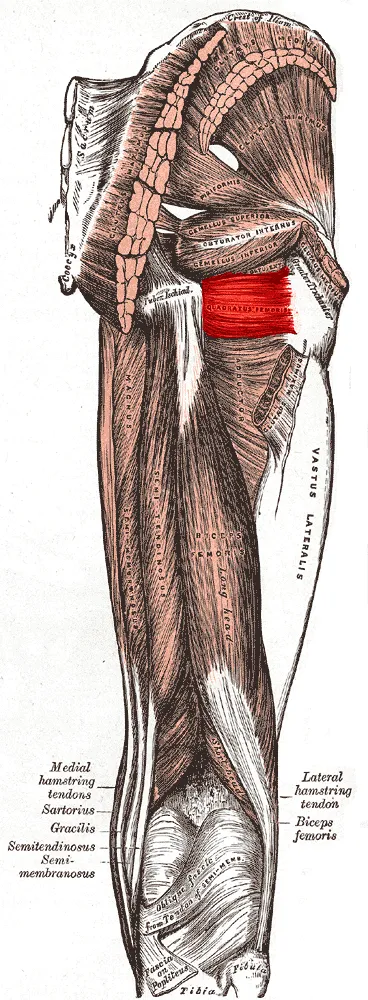

| Latin | Musculus quadratus femoris |
|---|---|
| Origin |
|
| Insertion |
|
| Action |
|
| Nerve | Nerve to quadratus femoris (L4–S1) |
| Group | Deep hip rotators |
| Name | Latin quadratus, 'squared', and femoris, 'of the thigh' — a flat, four-sided muscle. |
Palpation
- Client prone with a bolster under the ankles; stand beside the hip.
- Find the ischial tuberosity and the greater trochanter. Quadratus femoris fills the lower part of the space between them, level with the bottom of the buttock, under gluteus maximus.
- Sink in slowly with flat fingers just lateral to the ischial tuberosity and feel for a broad, firm band running straight across to the femur.
- Bend the client's knee to 90° and ask them to press the foot inwards against light resistance (hip lateral rotation); the band firms under your fingers.
The quadratus femoris is the lowest of the Deep hip rotators you can reach from behind. Its fibres run horizontally from the Ischial tuberosity (the “sit bone”) to the back of the femur, just below the Greater trochanter. Its upper edge lines up with the inferior gemellus (see Gemelli) and its lower edge with Adductor magnus.
It lies under Gluteus maximus, close to the top of the Hamstrings. When you work just lateral to the ischial tuberosity, fibres running across the buttock are likely to be quadratus femoris; fibres running down the thigh belong to the hamstrings. Use slow, broad pressure here and ask the client to report any tingling or pain spreading down the leg.
Besides rotating the thigh outwards, it also pulls the thigh towards the midline (adduction), so it works alongside the Adductors as well as the other deep rotators.