
| Functions |
|
|---|---|
| Structures |
|
For your massage practice
- Watching the client's breathing gives feedback - slow, deep breaths usually mean they are settling; breath-holding often means pressure is too much
- Accessory breathing muscles in the neck and chest (scalenes, sternocleidomastoid, pectoralis minor) often feel tight in people who breathe with their upper chest
- Clients with asthma or other breathing conditions may be more comfortable semi-reclined than flat, and some find scented oils irritating
- Postpone massage if the client has a fever or an active chest infection, to protect them and you
- Chest pain, severe shortness of breath or blue lips are an emergency - call 000
Overview
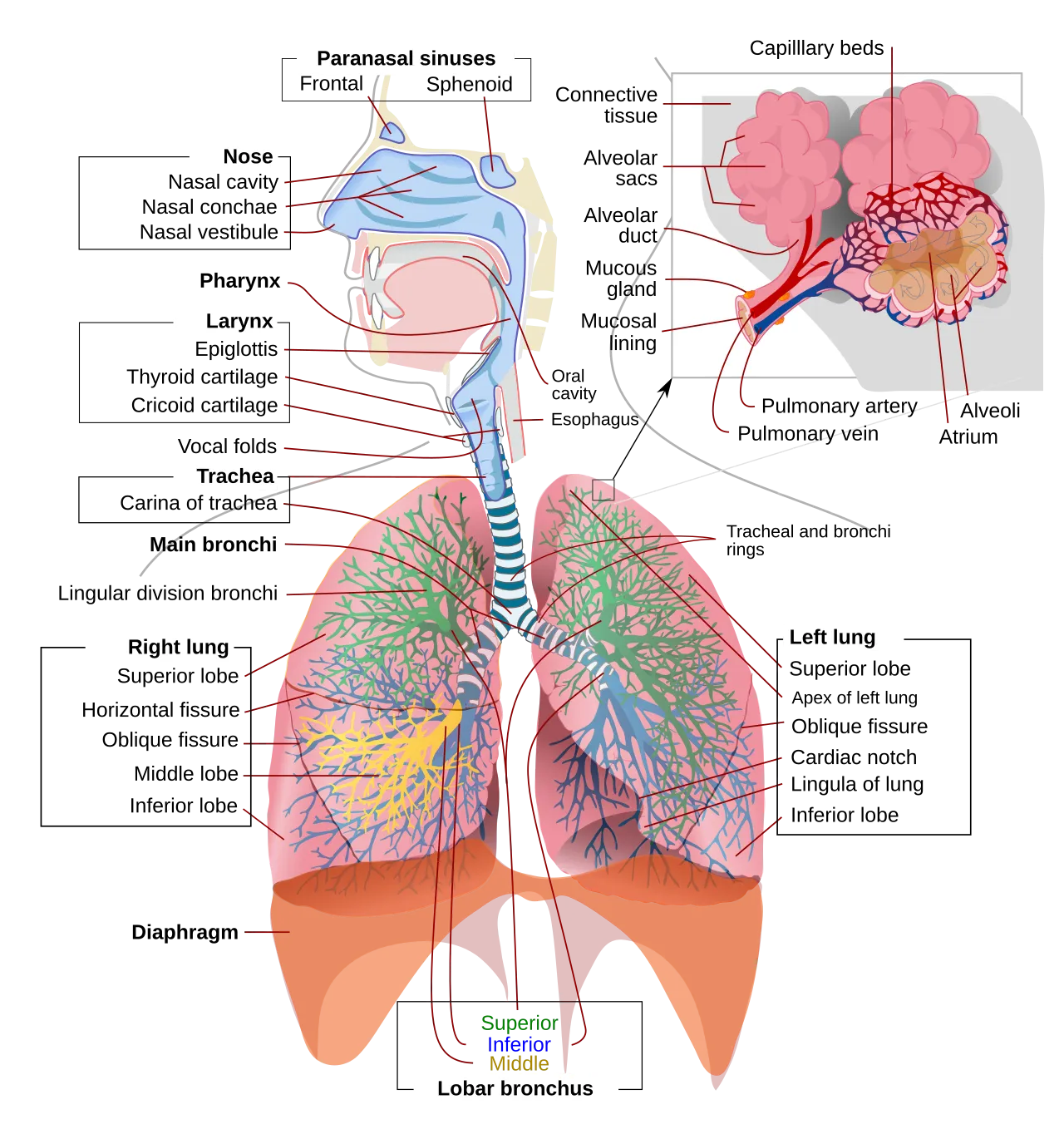
The respiratory system brings air close to the blood so oxygen can get in and carbon dioxide can get out. The upper tract (nose, pharynx and upper larynx) cleans, warms and moistens air. The lower tract (trachea, bronchi and bronchioles) carries it to millions of tiny air sacs called alveoli, where gas exchange happens. An average adult at rest breathes about 12–16 times a minute.
How it works
At rest, breathing in is driven mainly by the Diaphragm, a dome of muscle under the lungs. When it contracts it flattens, the chest gets bigger, pressure inside drops and air flows in. The Intercostals lift the ribs to help. Quiet breathing out is mostly passive: the diaphragm relaxes and the lungs recoil.
During hard breathing, accessory muscles join in. Muscles running from the neck and skull to the upper ribs and sternum, such as the Scalenes and Sternocleidomastoid, lift the upper chest; the abdominal muscles help push air out forcefully.
Relevance to massage
Breathing is one of the easiest things to observe during a massage. A client whose breathing slows and deepens is usually relaxing (see Relaxation and the parasympathetic response); one who holds their breath may be bracing against pressure. Cueing a slow breath out can help a client relax into a stroke.
People who habitually breathe with their upper chest often have tense scalenes, sternocleidomastoid and Pectoralis minor. Adjust positioning for clients with asthma or breathing conditions (a semi-reclined position may be easier), keep scents mild, and postpone treatment if the client has a fever or active chest infection. Severe breathlessness or chest pain needs emergency help.
Key terms
- Alveoli: tiny air sacs where oxygen and carbon dioxide are exchanged.
- Diaphragm: the main breathing muscle.
- Accessory muscles: extra muscles used in heavy or laboured breathing.
- Respiratory rate: breaths per minute.
Key terms
AlveoliDiaphragmInhalation and exhalationAccessory muscles of breathingRespiratory rateGas exchange